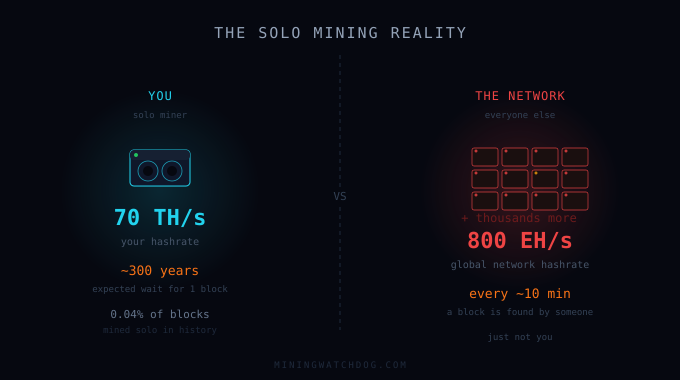
Bitcoin mining got a small breather this week, but nobody serious should confuse that with easy money. Difficulty stepped down, block times slowed, and BTC recovered toward the mid-$70,000s. In this bitcoin mining news, hashprice, the daily revenue miners earn per petahash per day, is still stuck in the low $30s. That means the real story is not relief. It is separation. Right now, miners are splitting into three camps: operators scaling the most efficient fleets, operators squeezing more life out of existing machines with firmware and tuning, and companies pivoting toward AI and HPC because pure mining economics still look tight.
What changed in Bitcoin mining this week?
The headline move was the Bitcoin difficulty adjustment on Apr. 17, which came down 2.43% to about 135.59T. Average block time during the epoch was roughly 10.43 minutes, so the network was clearly running slower than target. BTC also recovered into the mid-$70,000 range and pushed back toward the $77,000 area during the week.
This week in bitcoin mining news, the headline move was the Bitcoin difficulty adjustment on Apr. 17, which came down 2.43% to about 135.59T.
That helps. A lower difficulty number means each unit of hashrate has a slightly better shot at rewards, and a firmer BTC price gives miners a little more breathing room on revenue. But it does not reset mining economics. When hashprice is still hovering in the low $30/PH/s/day area, older fleets and high-cost operators are still under pressure. A small breather is not the same thing as a margin recovery. If you want the raw margin backdrop first, read ASIC Mining Profitability 2026: Why Most Miners Are Already Losing Money. And if you want the small-miner version of that same pressure, read Why Home Bitcoin Mining Is Getting Harder, and What Small Miners Should Do Now.
| Development | What happened | Why miners should care |
|---|---|---|
| Difficulty adjustment | Difficulty fell 2.43% on Apr. 17 to about 135.59T | Small short-term breathing room, not a real reset for margins |
| Bitdeer expansion | Bitdeer pushed to about 70 EH/s and kept rolling out SEALMINER | Scale plus efficiency still wins if you can execute |
| Canaan update | Canaan added more than 10 MW and kept all-in power near $0.044/kWh | Cheap power still matters more than headline hashrate |
| Braiins firmware | Braiins OS 26.04 shipped on Apr. 15 | Optimization is now a survival tool, not a hobby |
| TeraWulf AI pivot | More than 50% of Q1 revenue came from HPC hosting | Some miners are no longer betting on mining alone |
Which mining companies actually moved the needle?
Bitdeer is still the cleanest example of what scale plus vertical integration looks like right now. The company reported about 70 EH/s of self-mining capacity and 661 BTC mined, while continuing to push its SEALMINER line. The lesson for miners is simple. If you control infrastructure and keep moving to better fleet efficiency, you are still in position to gain share even when industry margins look ugly.
Canaan made a different but just as practical point. It added more than 10 MW, held average all-in power cost near $0.044/kWh, mined 89 BTC in March, and pushed treasury to 1,808 BTC plus 3,952 ETH. That is not a story about hype. It is a story about operating discipline. If your power cost is not competitive, your hardware decisions stop mattering very quickly. Buyers still working through that machine-by-machine should also read Is Your ASIC Miner Still Profitable in 2026? The Honest Numbers.
TeraWulf leaned harder into a model many miners still do not want to admit is becoming mainstream. More than 50% of Q1 revenue came from HPC hosting, it disclosed allocations for a revolving credit facility of up to $250 million, and it paired that with a $1.04 billion common stock raise for data center buildout. For buyers and smaller operators, the message is not to copy TeraWulf blindly. It is to understand that some public miners are already treating Bitcoin mining as only one line of business, not the whole business.
- Bitdeer shows why serious scale now has to be paired with top-tier efficiency.
- Canaan shows why power cost discipline still beats flashy expansion.
- TeraWulf shows where the industry is going when mining alone no longer offers enough certainty.
The biggest hardware and firmware signals miners should not ignore
The hardware signal this week was obvious. Bitdeer is not just talking about chips. It put real specs on the table. The SEALMINER A4 Ultra Hydro came in at 886 TH/s and 9.45 J/TH, while the Pro Hydro and Pro Air landed around 10.9 J/TH. Those are the kinds of numbers that matter when difficulty relief is small and every watt still counts.
The firmware signal matters just as much. Braiins OS 26.04 landed on Apr. 15 with Continuous Tuner beta, improved hydro tuning, broader support, and downloadable full log archives. That might sound like shop-floor stuff, but this is exactly where margins get defended now. When replacement cycles are harder to justify, tuning stable machines better can beat rushing into a fresh capex decision. And if you are still comparing buy-new versus keep-running decisions, this pairs well with Buying ASIC Miners in 2026: New vs Used. What the Calculators Don’t Tell You.
| Option | Key spec or update | What it means for buyers |
|---|---|---|
| SEALMINER A4 Ultra Hydro | 886 TH/s at 9.45 J/TH | Shows where next-wave efficiency targets are heading for industrial buyers |
| SEALMINER Pro Hydro / Pro Air | About 10.9 J/TH | Confirms the market is still rewarding efficient SHA-256 hardware, not cheap old inventory |
| Braiins OS 26.04 | Continuous Tuner beta, hydro tuning upgrades, broader support | If you already own decent machines, firmware may produce a better return than impulsive replacement |
| Hosted S21 XP pricing signals | Hosting markets are still paying up for proven efficient units | Buyers should benchmark offers against operational cost, not just sticker price |
If you are shopping hardware right now, start with proven SHA-256 machines that already have real market depth, parts availability, and resale visibility. That is why it makes more sense to compare live offers for Bitmain Antminer S21 XP+ Hyd, Antminer S21 XP Hyd, and Bitmain Antminer S19 XP Hyd than to chase whatever machine looks exciting on a press release slide.
What miners are really doing right now
They are selling more treasury. Public miners sold more than 32,000 BTC in Q1, which tells you the pressure is real even for listed operators. They are also watching import costs and tariff risk more closely than a lot of people outside the business realize. The machine price on paper is only one line item. Landed cost can change the whole math.
And they are getting more serious about firmware, tuning, and uptime. Blind expansion is harder to justify when hashprice is weak and BTC has not fully bailed out the fleet. This is why the operators still making smart moves look different from the last cycle. Some are scaling. Some are optimizing. Some are building toward AI and HPC because pure mining revenue still does not offer enough cushion.
What I would actually do if I were buying miners right now
If my power was expensive, I would stop pretending an outdated bargain machine is a strategy. I would rather buy fewer efficient units than load up on older gear that only looks cheap until the electricity bill lands.
If I had cheap power, I still would not buy based on hype alone. I would focus on machines that already have broad market demand, proven uptime, and realistic support options. That usually means sticking close to strong SHA-256 inventory instead of gambling on whatever just got announced. Anyone still trying to brute-force ROI from a spreadsheet should also review BTC Mining Calculator 2026: Exact Antminer S21 ROI at $0.05 to $0.15/kWh.
If I already owned decent hardware, I would seriously test firmware optimization before replacing the whole fleet. In this environment, better tuning, cleaner logs, tighter thermals, and smarter power profiles can do more for cash flow than an emotional hardware refresh.
If I were buying right now, I would stay focused on reliable sellers and proven machines. I would rather compare current SHA-256 ASIC miner listings and the broader Marketplace product inventory than chase a story stock mentality into a mining purchase.
Where I would look for Bitcoin miners right now
I would start in the SHA-256 ASIC miners category because that is where the current Bitcoin-specific options are easiest to compare side by side. From there, I would check the full products page to see what is live across hydro, air-cooled, and other current inventory.
For machine-level comparisons, I would look closely at live listings for the Antminer S21+ and the Antminer S21 XP Hydro. Those are the kinds of machines that let buyers compare real efficiency, seller quality, and realistic deployment fit instead of chasing abstract specs.
This week did not magically make Bitcoin mining easy again. It gave efficient operators a little room to breathe and reminded everyone else that weak fleets still get punished fast. The miners who win from here will not be the loudest ones. They will be the ones with cheap power, disciplined hardware choices, better tuning, and no illusion that a single easier difficulty adjustment fixes a broken cost structure.