Can a home miner still solo mine Bitcoin in 2026? Yes, but for most people it is a variance bet, not a business model. Solo wins still happen, and April 2026 gave everyone two fresh examples on CKPool. But against a Bitcoin network around 1 ZH per second, a single home miner has odds so small that pool mining remains the rational default for almost everyone.
That is the answer people need before they get pulled into jackpot screenshots. If you have not checked whether your hardware is profitable at all, start with the 2026 ASIC profitability breakdown. If you are still choosing hardware, read the new versus used ASIC guide before you convince yourself that variance is the main problem.
How rare are solo Bitcoin block wins in 2026?
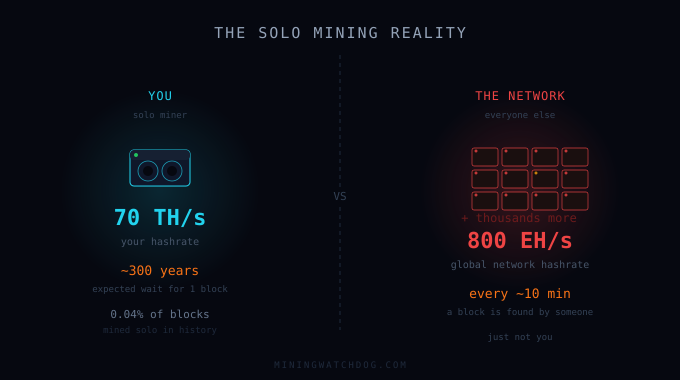
They are rare enough that one viral win distorts the whole conversation. In the last 12 months, more than 52,000 Bitcoin blocks were mined. Fewer than 22 were credited to solo miners. That is roughly 0.04% of all blocks.
So yes, the winners are real. The story people build around those winners is the misleading part. For every miner you saw celebrated online, thousands of miners spent months running hardware and collected nothing.
| 12-month block outcome | Approximate count | Share of all blocks |
|---|---|---|
| Pool-mined blocks | About 52,000 | About 99.96% |
| Solo-mined blocks | Fewer than 22 | About 0.04% |
That does not make solo mining fake. It makes solo mining a low-frequency, high-variance outcome. If you want to compare that variance against more stable ROI math, the BTC mining calculator breakdown shows what predictable daily mining math looks like instead.
What does 1 ZH per second mean for a home miner?
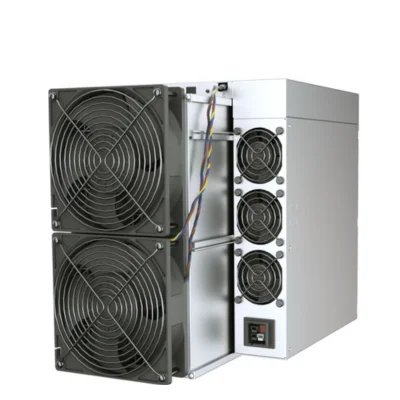
It means scale is doing most of the talking now. A top-end home unit such as the Antminer S21 Pro still only represents a tiny slice of a 1 ZH network. A base Antminer S21 is smaller again.
- 70 TH per second is roughly 0.000000007 of the network share.
- 230 TH per second is still a very small fraction of total network power.
- 1 PH per second sounds large until you remember it is just 0.0001% of a 1 ZH network.
That is why the solo-mining debate is really a probability debate. Network scale does not care how committed you are. It only cares how much share you control.
What are the real solo mining odds by hashrate?
If you use simple expected-value math against a 1 ZH network, the picture gets uncomfortable fast.
| Hashrate | Expected solo block time | What that means in practice |
|---|---|---|
| 1 TH per second | About 19,000 to 21,000 years | Pure lottery territory |
| 70 TH per second | About 272 years | Still unrealistic as an income plan |
| 230 TH per second | About 83 years | Better odds, same basic problem |
| 1 PH per second | About 19 years | Human timeframe, but still brutal variance |
And here is the part most people miss: expected time is not a countdown timer. Bitcoin does not remember that you have been mining for two years. Each block is a fresh independent event. You are never “due.”
If you are trying to run a serious mining operation instead of buying entertainment with a power bill, pool mining is the adult answer. The profitability article explains why efficient hardware and power pricing matter more than jackpot fantasies.
Solo mining versus pool mining: what actually changes?
Expected value per terahash is broadly the same. What changes is how the payout arrives.
- Pool mining converts variance into smaller, regular payouts.
- Solo mining keeps the full reward upside and all of the wait-time pain.
- Pool fees usually cost 1 to 3%, which is cheap compared with multi-year revenue droughts.
That is why I tell miners to solve the operating model first. If your machine is barely profitable in a pool, it does not become a strong business just because you flip the payout format.
Hardware selection still matters, too. If you are choosing between machines, compare the live SHA-256 miner listings and then read the guide on buying ASICs in 2026. A weak buy decision makes solo mining look even worse.
When solo mining can still make sense
I would not call solo mining irrational in every case. I would call it misused.
- Near-zero electricity can justify a long-shot strategy.
- Large hashrate, especially multiple petahash, can make the variance easier to stomach.
- Some miners simply want the thrill and understand the economics going in.
- On smaller proof-of-work networks, the math can be far more forgiving than Bitcoin.
If you are exploring those smaller algorithm markets, the VolcMiner D1 Hydro review is a good example of how different payout profiles and hardware classes can change the conversation.
What I would actually do in 2026
If I wanted predictable cash flow, I would buy efficient hardware, point it at a reputable pool, and keep variance under control. If I wanted to take a calculated swing with surplus hashrate and cheap power, I might peel off a portion for solo mining and treat it like an informed bet.
Either way, I would buy through a marketplace where I can compare live hardware and vetted sellers first. Start with all marketplace listings and the supplier directory, not a random screenshot in a Telegram chat.
FAQ: Solo Bitcoin mining in 2026
Can a home miner still win a Bitcoin block solo?
Yes. It still happens. The point is that it happens rarely enough that most miners should treat it as variance exposure, not as a revenue plan.
Does mining longer improve my odds on the next block?
No. Each block attempt is independent. Time served does not improve your probability on the next block.
What hashrate starts to make solo mining less absurd?
The pain starts to become easier to frame once you are measured in petahash, not terahash. Even then, the wait can still be measured in years.
Should I solve profitability first or payout strategy first?
Profitability first, every time. That is why I would read the profitability guide and the BTC calculator guide before obsessing over solo-versus-pool ideology.